Imaad Majeed’s journey into making sample-based music from recordings of Sufi music from Ilankai — under the moniker of KANNOORU — began over the course of Ramadan in 2021. Chopping up samples on the free and open-source Audacity, their unreleased 7-track demo was awarded a production grant from Experimenter’s Generator Co-operative Art Production Fund. Since then, with Ableton, an analogue synthesizer and an MPC-style drum pad at hand, they’ve further delved into exploring resonances within and across their archive of Sufi sonics. Rhythms of the daff and darbuka are struck in staccato, against the voices of devotees stretched into ambient washes like waves lapping at the shore, before a synthesized harmonium introduces melodies drawn from Arabic maqam and regional influences — all evoking a lost past and a future that may never be.
What might the relegation of Sufism as shirk (idolatry) and unislamic by reformist Islamic movements — sound like? What might the abandoning of Sufi practices by Muslims of the island — sound like? Employing found sounds, KANNOORU attempts to refract the state of the existing archive of Sufi sonics in Ilankai, which encompass the Rifai, Naqshbandi, Qaddiriya, Mufliheen, and Shazuliya orders, and the correlating sacred sites and communities, while speaking from its continuous erasure.
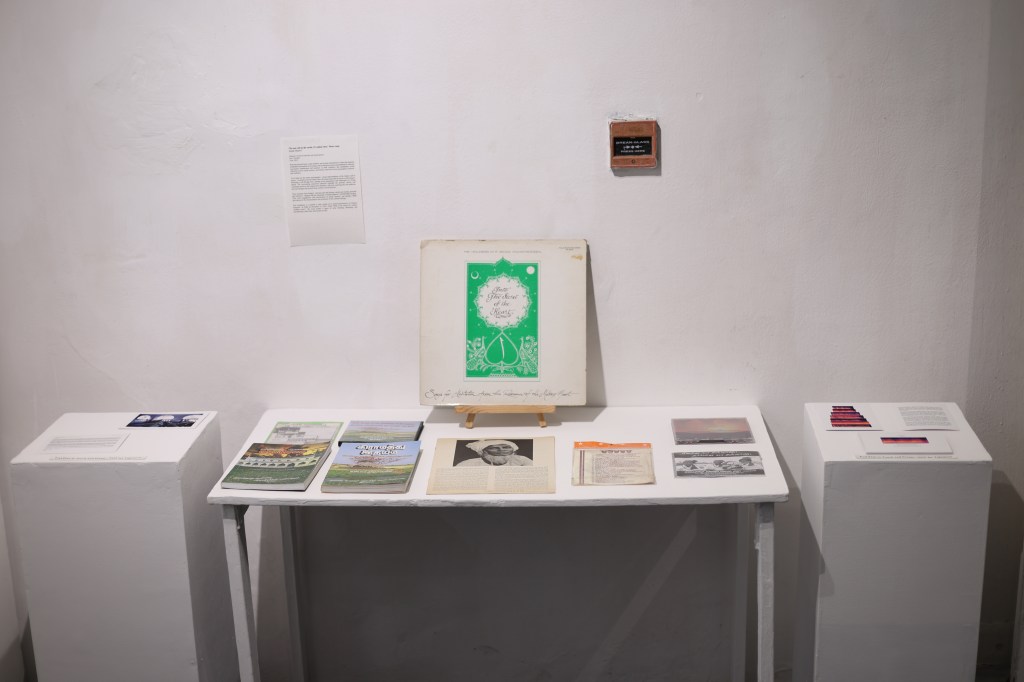
“Do not roll on the earth, O Golden One,” Bawa sang
Imaad Majeed
Archival materials and Spectrograms
2024
Exhibited as part of Najrin Islam’s curatorial debut “Notes on Omission”
Weaving spectral traces, sonic artefacts, and textual explorations to reflect the histories of Muslim communities in Ilankai, and resisting the erasures precipitated by reformist movements condemning Sufi practices as shirk (idolatry), this installation invites reflection on how sound, memory, and identity intertwine across geographies, histories, and traditions.
At its heart are the azaan spectrograms — visual representations of the Islamic call to prayer — recorded across the island. Here, the azaan transcends its role as a call to prayer, becoming a call through time, echoing across generations and landscapes as a living thread. The surrounding anarchival materials highlight the spiritual, artistic, and communal practices that shaped these identities, with texts exploring the oral traditions and clan lineages that ground these sounds in lived histories.
These elements form bridges — between past and present, sacred and secular, personal and collective—aligned with the intentions of Imaad Majeed’s KANNOORU project. They invite engagement with intersections of sound, memory, and identity, while advocating for the documentation and protection of this cultural heritage.
This installation was a prelude to (and residue of) a lecture-performance in Delhi on December 14, 2024. Titled ‘What is the sound of a culture washing away?’, the event created a space of close listening, lamenting, and remembering, where time itself seemed to echo.
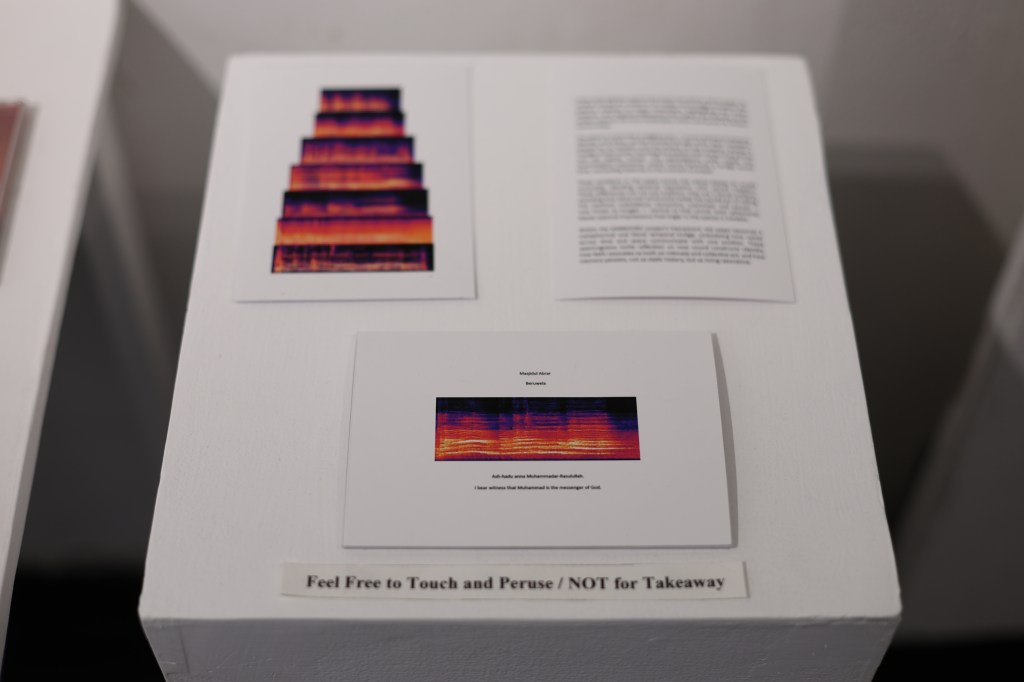
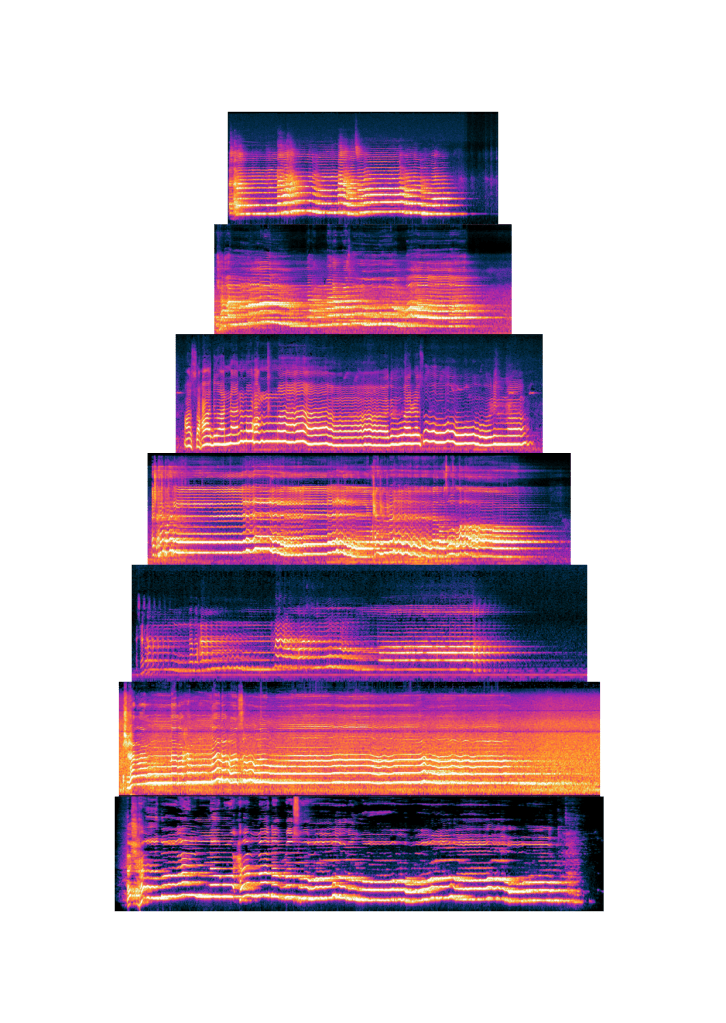
These spectrograms capture the azaan, the Islamic call to prayer, as recited around the island of Ilankai. Each image visualizes the spectral qualities of these invocations, highlighting the tonal, rhythmic, and regional differences that reflect the diversity of Ilankai’s cultural and sonic landscapes, within and across its Muslim communities.
The azaan is more than a religious act — it is an archive of memory, identity, and place, carried forward through voice. Each recitation, shaped by its location and the timbre of the muezzin, echoes a lineage of past voices, haunting the present with traces of the divine and the deeply human. The spectrograms make visible this hauntological resonance, where sound becomes a bridge across time, connecting histories to the moment of prayer.
These variations in the azaan across the island display its innate musicality, blending personal expression with sacred tradition. These differences are not just auditory; they are cultural artifacts, revealing how place and community shape the sacred act of calling. The rhythmic undulations, harmonics, overtones, and pauses — now frozen as images — remind us that sound, even ephemeral, leaves spectral impressions that linger in the spaces it inhabits.
Within the KANNOORU project’s framework, the azaan becomes a metaphorical and literal temporal bridge, embodying how voices across time and space communicate with one another. These spectrograms invite reflection on how sound constructs identity, how faith resonates as both an intimate and collective act, and how memory persists, not as static history, but as living resonance.
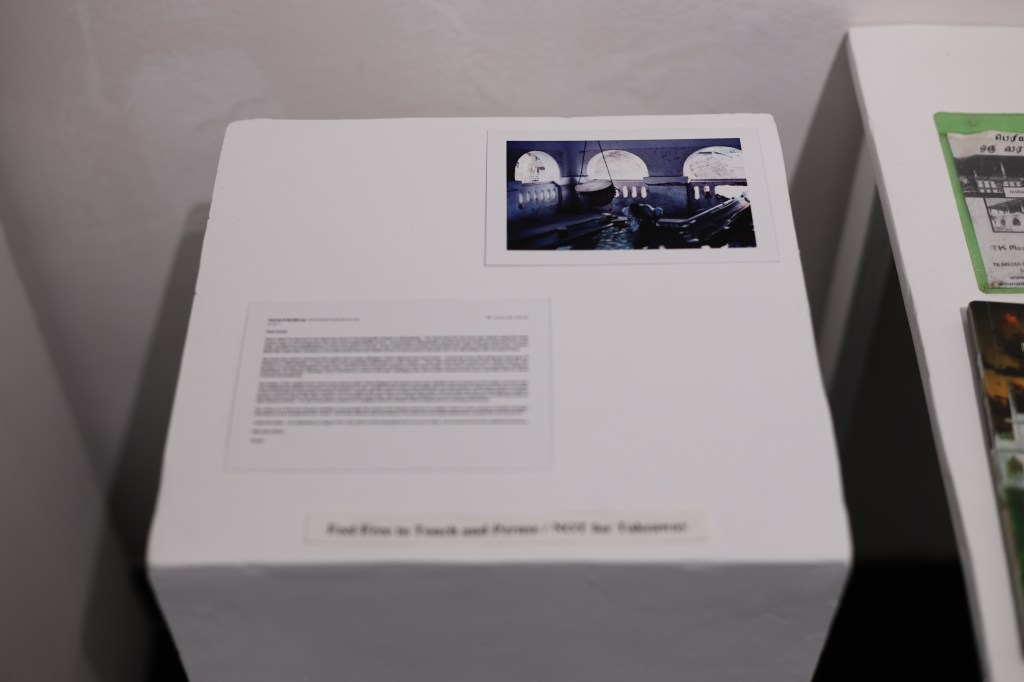
“Questions of Jailani”
Imaad Majeed
Field recordings
2025
Exhibited as part of Listening Biennial’s Third Listening, curated by Soledad García Saavedra, Alecia Neo and Suvani Suri with Brandon LaBelle
“Questions of Jailani” is a sound-based artwork that explores the contested sacred site of Dafther Jailani in Kuragala, Ilankai – a place where overlapping mythologies, militarized nationalism, and religious orthodoxy converge to distort plural histories. Once an overflowing Sufi shrine, Jailani has become a battleground of authenticity– Sinhala Buddhist nationalists seek to reframe it as a prehistoric archaeological site devoid of Muslim presence, while orthodox Sunni factions reject its mystical practices as idolatry. In this struggle over origins, shared memory is dismantled to make way for singular, purified narratives.
This work constructed from field recordings gathered in collaboration with artist Abdul Halik Azeez, listens closely to the space. A military personnel sweeps the grounds while Buddhist chants echo faintly. We hear the sounds of nature as the invocation “ameen” is stretched into a spectral resonance, unsettling the boundary between human and non-human utterance.
Inspired by a caretaker’s account of encounters with the jinn of nearby Jinni Malai, who claimed the politics of our realms are interconnected, the work considers listening as a method of resistance and speculation. In an attempt to hear the more-than-human realm and the unresolved memory it holds, it asks: what is the sound of Sinhala Buddhist colonization? What survives in the silence now that the fakhirs no longer dwell there? Questions of Jailani is not a restoration of lost sound, but an invitation to attune to what remains: echoes, hauntings, and entanglements across time, faith, and species.
 IMAAD MAJEED