A close friend and fellow poet asked me how I write about matters that do not directly affect me or that I have not personally experienced. She felt unease in adopting perspectives beyond her own. In a field where empathy — its capacity, enactment, and actionability — is considered vital to resilience and survival, such a question disrupts normative assumptions: How knowable is the pain of others? What are the boundaries of empathy? Is there such a thing as emotional appropriation?
Testimony, wit(h)nessing, and the politics of emotion
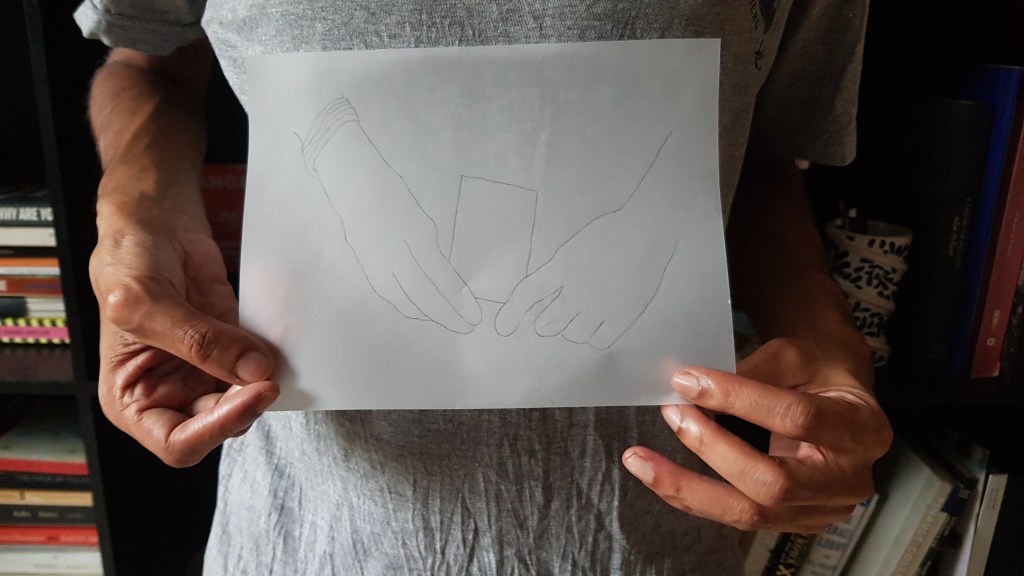
These questions are central to my own artistic practice. In this newsletter, I reflect on the process of creating “Testimony of the Disappeared” (2021–2022), a documentary poetics zine, a series of posters, and tracings that challenge the very impossibility of testimony. In response to Holocaust denialists who claim we cannot speak of the gas chambers because no survivors remain, Jean-François Lyotard introduced the concept of the differend — a situation in which the unsayable demands to be said, forcing us to invent new idioms.
When I completed the work, I shared it within our artist collective. One curator called it “a body of work,” while an illustrator described it as “a body of pain.” “There is so much pain here. How did you hold so much pain? I could not,” she said. Having spent a decade working in media and journalism, I could have become desensitized to this weight. The newsroom is a space of ritualized desensitization.
However, with “Testimony of the Disappeared”, I chose to step outside what I had learned in journalism school and post-war newsrooms. In a newsroom, an editor would have sent me to Jaffna with 10 questions and a predetermined angle, ensuring I spent just an hour with those affected to collect material, then returned to Colombo to shape it into a story. For this project, however, the curator invited me to explore language, witness, and testimony in ways that felt unfamiliar. She suggested I read Veena Das’ “Trauma and Testimony: Implications for Political Community” (2003) and Bracha Ettinger’s “Wit(h)nessing Trauma and the Matrixial Gaze” (1995), which deeply influenced my conversations with the families of the disappeared.
Reading Veena Das gave me a new ear for listening. Das argues that testimony isn’t just an individual act of remembering, but a collective practice that reshapes political belonging. Trauma, she writes, “solicits a wider sense of social life,” inviting communities to reconfigure themselves in response. Testimony, then, isn’t just telling — it is a political act that reknits social bonds. In conversations with families of the disappeared, I realized their words were not isolated expressions of grief, but contributions to a collective reweaving of community memory.
From Bracha Ettinger I learnt another kind of attentiveness. Ettinger critiques Lacan’s phallic gaze and introduces a “matrixial sphere” — a feminine-maternal, pre-natal psychic space of ethical trans-subjectivity. In this schema, withnessing (her hyphenated gesture) shifts the act of witnessing into a shared border-space where partial selves meet without merging. Through this matrixial encounter, trauma is not simply observed — it is co-experienced and co-responded to with compassion.
These frameworks reconfigured my listening. With Das, I came to hear testimony as a political weaving of connection, a communal act of naming and belonging. With Ettinger, I learned to attend not from outside, but from alongside. I learned to hold the boundary — hosting pain without appropriating it, responding without consuming it.
In “Testimony of the Disappeared”, then, my role was less reporter and more matrixial host. I created spaces — through posters, zines, tracings —where testimonies could be given form, resonated with, but not dissolved. I practiced holding partial selves in resonance, respecting the sacred “between” rather than collapsing into identification.
These influences continue to guide me: listening as political weaving, witnessing as compassionate presence, testifying as cultivating a shared border-space of memory, accountability, and mutual becoming.
And so I listened.
At first, the mothers would share the information they had been accustomed to giving, shaped by their interactions with journalists, NGOs, and government bodies. But over time, as they realized I was intent on continuing to listen, their language opened up. They began to express things I had never encountered in newspapers, journals, or through activists.
I listened for three hours.
In “The Cultural Politics of Emotion” (2014), writer, scholar and feminist killjoy Sara Ahmed writes, “Pain is not simply an effect of a history of harm; it is the bodily life of that history.” She reflects on the “Bringing Them Home” report (2006), which details the experiences of Aboriginal and Torres Strait Islander children forcibly removed from their families during the Stolen Generations in Australia. This violence was not just inflicted on the individual body, but on the collective skin of the community. Ahmed writes, “When considering the damage to the bodies of indigenous Australians, we can think about not just the individual’s skin surface, but the skin of the community. The violence was not simply inflicted upon the body of the individual who was taken away, but also on the body of the indigenous community, which was ‘torn apart.’”
In “Notes on Trauma and Community” (1995), Kai Erikson suggests that collective trauma is “a blow to the basic tissues of social life that damages the bonds attaching people together.” Ahmed extends this: “The skin of the community is damaged, but it is a damage that is felt on the skin of the individuals who make up that community.” The testimonies in “Bringing Them Home” are not only of individual suffering but of collective harm. Yet while these stories must be heard, Ahmed questions: What are the conditions for hearing them?
In the context of Australian politics, the act of compiling these testimonies does not guarantee that the stories are truly heard. Similarly, in Sri Lanka, the creation of “Testimony of the Disappeared” does not ensure the stories of the disappeared are truly heard — or if they are, that they are heard justly.
“Bringing Them Home” is a document concerned with healing, asking that the nation listen with open hearts and minds to the pain of the Stolen Generations. The document emphasizes the importance of recovery, not forgetting, both personal and national. But Ahmed critiques the paradox in this approach: While the testimonies of indigenous Australians demand national shame, white readers are allowed to remain distanced from the history, the responsibility is placed on the nation rather than individuals.
Reconciliation, as this narrative constructs it, is the reconciliation of indigenous individuals into the white nation, which is now cleansed through its expression of shame. Fiona Nicoll, in “B(l)acklash: Reconciliation after Wik” (1998), argues that reconciliation has a double meaning: it suggests coming to terms with the past, but it can also seek to make the other passive, to “reconcile” them to their fate. In Australian politics, this process often involves attempting to fit indigenous people into the white national narrative. Similarly, in Sri Lanka, reconciliation is often bound by the violent forces of inclusive nationalism, which demands that the “other” conform to a singular identity.
Ahmed further critiques the emotional appropriation that occurs when non-indigenous Australians claim the national pain of the Stolen Generations as their own. “The recognition of the wound of the stolen generation,” she writes, “provides, in the terms of the document, ‘our identity as a nation.’” This claim to national pain becomes an erasure of the indigenous experience, turning their suffering into a narrative of collective healing for the nation. To empathize with the other’s pain in this way, Ahmed argues, is a form of violence. “To hear the other’s pain as my pain, and to empathize with the other in order to heal the body (in this case, the body of the nation), involves violence.”
For Ahmed, the task is not to forget the pain, but to learn how to hear what is impossible: “Such an impossible hearing is only possible if we respond to a pain that we cannot claim as our own. Non-indigenous readers do need to take it personally (they are part of this history), but in such a way that the testimony is not taken away from others, as if it were about our feelings, or our ability to feel the feelings of others.”
How to read pain and not be a ‘saviour’
On Mullivaikkal Remembrance Day, May 18, human rights lawyer and human rights activist Ambika Satkunanathan posted to her social media followers: “Don’t ‘save’ us. 16 years. It’s an advocacy issue. For some. ‘Saving’ us. While encroaching our space, appropriating our voice. It’s life long pain and grief. For us. Tamils. Struggling against othering. For justice. For equality. For respect. To be heard. To be seen. To remember freely. Exhausted. 16 years. We continue.”
It stung to read.
Her words — raw, declarative, resisting containment — remind us that the labor of grief and resistance is ongoing, and that even recognition can feel extractive. Satkunanathan’s demand is not for remembrance as performance or allyship as absorption, but for space, for voice, for Tamil self-determination in the face of continuous erasure.
This insistence — that grief is not to be claimed, that exhaustion is not to be alleviated by another’s advocacy — finds a necessary echo in Sara Ahmed’s reflections on affect, testimony, and the politics of reading. In her writing on “Bringing Them Home”, Ahmed offers a mode of reading that resists empathy as appropriation. She describes how difficult testimonies of grief “move on me and move me” — not as emotional catharsis, but as a confrontation with histories one cannot escape.
Reading such testimonies, Ahmed writes, “I am jolted into [their world]…unbelievable, too believable, unliveable and yet lived.” This double movement — of being drawn in and held at a distance — resonates with “Testimony of the Disappeared”, which gathers accounts from the families of the forcibly taken, the never-returned, through the reports of commissions of inquiry deployed by the Sri Lankan state. In these testimonies, too, we are asked to witness without claiming to know. We are implicated, yes — but that does not entitle us to identification.
Ahmed names this unsteady position as a kind of “un-housing.” Knowing oneself to be part of a history of violence — whether through complicity, inheritance, or proximity — is not simply about “learning” the past. It is about being displaced by it, inhabiting one’s own life differently. She writes, “I cannot learn this history… and remain the same.” What is disrupted here is not just the past but the present ground of our ethical and political lives. Recognition is not a gesture of generosity; it is a transformation of the self and its relations to land, memory, and community.
This refusal of comfort is mirrored in how Ahmed approaches the testimony of Fiona, a woman taken from her family as a child under the Australian government’s assimilation policies. Fiona’s story, shared in fragments and gestures, performs the wound it describes. She recalls a mother curled in the foetal position, a scream she can still hear decades later, a community torn apart before her eyes. The loss is total, and yet survival persists — not in triumph, but in a body reshaped by injury, a language muted, a memory that never finishes remembering.
Ahmed resists interpreting Fiona’s story as a redemptive narrative. There is no clear “them” to blame, no satisfaction in righteous anger. Even when Fiona names those responsible — the missionaries, the state — her account does not indulge in recrimination or forgiveness. Instead, there is a kind of suspended grief, what Ahmed calls “a pain that cannot be shared through empathy.”
This, too, is what Testimony of the Disappeared encounters again and again. Stories where grief fractures into repetition, where loved ones search for the right to mourn in public, to mark absence without state interference. Techniques of black-out poetry and rearranged language via Markov chain are used to represent the commissioner’s behaviours of interrupted storytelling and disrupt and fragment the testimonies. The work cites academics that point to a lack of empathy from the commissioners. And as Ahmed reminds us, “the impossibility of fellow feeling is itself the confirmation of injury.”
To respond, then, is not to claim the pain, but to dwell in its unshareability. It is not to say “we feel this too,” but to accept that we cannot, and still be present. The work of witness is emotional, but it is not about self-soothing. It is political because it requires an unlearning of entitlement to another’s truth. Ahmed writes: “The testimonies of pain… are not only calls for recognition; they are also forms of recognition.” They make visible the violence that history tries to obscure —not through the spectacular, but through the intimate and ordinary.
Satkunanathan’s declaration — “Don’t ‘save’ us” — functions in this same register. It insists on boundaries, on the specificity of Tamil pain. It warns against the ease with which grief can become a symbolic currency, traded for proximity, validation, or moral clarity. Ahmed cautions similarly: “Would Iraqis, Afghanistanis want the force of Western grief to transform them into losses?” What is at stake in these questions is not just representational justice but the ethics of relation: who gets to feel, who gets to name, who gets to move on.
For those who speak from within the loss — like Fiona, like the families of the disappeared — telling is not therapeutic in the conventional sense. It is not about closure. Rather, it is about survival: about insisting on the wound as a site of truth that demands truth, about giving form to what cannot be restored while demanding justice and accountability. Ahmed writes, “Healing does not cover over, but exposes the wound to others.” Telling is an act of exposure, not for empathy but for political rupture.
Still, she acknowledges, there must be space for “feeling better” — not as resolution, but as sustenance. In contexts where survival itself is an act of resistance, feeling better might mean “having energy, shelter, warmth, light, or air to breathe.” It might mean silence without shame, remembrance without surveillance. Justice cannot guarantee healing, but it must allow for conditions in which healing might be possible.
This is where Ahmed’s reflections return most urgently to Satkunanathan’s statement. The call is not for pity, nor even for solidarity as it is often understood. It is a call for non-interference, for listening without remaking the speaker. A call to stand beside, not in place of. To resist the pull of narrative closure, of redemptive arcs, of saviour fantasies.
In “Testimony of the Disappeared”, I hope I was able to honour that call by attending to the grief without consuming their grief. By foregrounding rupture, ambiguity, silence. By refusing to speak for, and instead creating the conditions for others to speak to. I wanted to produce a document that would visualise the harm of interrupted storytelling and official amnesia, while also bringing together critical texts, journalism, and interviews with those close to the issue, in such a way that, as a poet, I act as a conduit.
As Ahmed writes, “Recognition of injustice is not simply about others becoming visible… it is about claiming that an injustice did happen.” The act of telling, repeated again and again, may not be enough. But it is a beginning: an exposure, an opening, a refusal to forget.
Looping into and out of the interiority of others
In “I Am a Strange Loop” (2007), cognitive and computer scientist Douglas Hofstadter explores the recursive, self-referential nature of consciousness. For him, to understand another person is to recreate a “loop” of their self within your own — a kind of mental simulation. He sees this capacity as central to empathy: your “I” includes, to some extent, internal models of other “I”s.
Empathy, in this account, is ontological. The self is always already shaped by others. Hofstadter’s vision leans toward humanist optimism — we are porous, entangled, strange loops inside one another. But unlike the sentimentality critiqued by Sara Ahmed, Hofstadter’s empathy is not a performance of feeling — it is a structural intimacy. A way of being-with that changes the architecture of the self.
Ahmed reminds us that feeling bad about injustice is not the same as undoing injustice. She warns against forms of empathy that comfort the privileged rather than confront the conditions of violence. Hofstadter does not oppose this critique, but shifts the emphasis: real empathy is not comfortable. It is disruptive. To feel what another feels — truly — is to be reconfigured by that feeling.
What does it mean, then, to be a person? For Hofstadter, it is not merely to occupy a body, but to carry a distinctive psychic pattern — a history of memories, associations, reflexes, vulnerabilities. And crucially, this interiority isn’t sealed. It can be mirrored in others. It can be hosted, even partially, in another brain.
He likens this to language acquisition. At first, fluency is artificial — you translate internally. But over time, a second language embeds itself. You begin thinking in it. In the same way, to inhabit another’s interior world — their rhythms, their affective logic — is to become, as he puts it, a “fluent be-er” of them.
In long relationships, Hofstadter observed, people internalize each other deeply. After years with his wife Carol, he shared not just her memories or preferences, but her responses, her dreams, her dread. “So her point of view, her interiority, her self, which had originally been instantiated in just one brain, came to have a second instantiation,” he writes.
This second instantiation is partial — never as rich as the original — but it’s real. Even before they met, Carol’s self lived in fragments across others. We all carry echoes.
Sometimes this resonance is shallow, like mimicry. Hofstadter recalls a friend impersonating a professor — not just voice, but affect. It was funny because it touched on essence. But deeper resonance goes beyond gesture. It lives in shared structures of feeling.
Two people might say “Chopin is a great composer,” but unless they feel it in the same key, the belief floats. Emotional congruence matters more than factual agreement. True resonance arises not from what we say, but from how we’re made — temperament, fear, doubt, hope. Someone who’s never felt shame or paralysis can’t easily imagine it. As Ambika Satkunanathan notes in her reflections on empathy and political response, without structural understanding, emotional identification alone risks condescension.
So — can another’s “I” be hosted inside your self, not as an act of possession, but of presence? Hofstadter thinks yes. To be someone else — in a profound way — is to adopt their vantage, live their values, grieve their losses, share their soul. It is not a metaphor. It is a practice.
This is where mourning becomes ethical. If you’ve internalized someone deeply, can you keep a part of them alive? Can your brain serve as a second neural home? Can their loop persist in you?
Hofstadter calls this “representational universality” — the human capacity to simulate what we haven’t lived. From a story, a fragment, a gesture, we can build an interior model. We see a person across a courtroom, hear a mother’s testimony, read a redacted file — and still something enters us.
He gives a simple example: watching a webcam of their dog from 2,000 miles away. They could read its posture, its pacing. But the dog could never comprehend the surveillance, the symbolic distance. “Dogs’ brains are not universal,” he writes. Humans can imagine abstraction, metaphor, pain-at-a-distance.
This capacity, Hofstadter suggests, is what makes a soul. To loop others inside us — not sentimentally, but with fidelity — is what grants depth to our response. And it’s what makes witnessing more than a record. It makes it a responsibility.
As Ahmed would frame it, this kind of “being with” doesn’t smooth over difference. It holds space for it. Empathy, when practiced as structural imagination, isn’t about feeling-good. It’s about being undone — and remade — by another’s truth.
Practicing the sacred loop: Interiority as wit(h)ness-practice
I came to Hofstadter while reading about Sufism in Sri Lanka. In “Accessing the Interiority of Others” (2019), Victor C. de Munck and Christopher Manoharan identify three levels of interiority: the phenomenal, the dispositional, and the deepest. The phenomenal refers to surface cues — expression, posture, tone — which strangers can read. The dispositional refers to inferred values, desires, or habits built through long-term relational knowledge. The deepest level is reserved for the beloved: those whose interiority feels shared, whose worldview is no longer just observed but inhabited.
In Sri Lankan Sufi contexts, these levels correspond to ritual forms. The Burdha kanduri — a public village festival — maps onto the phenomenal level. Weekly dhikr (remembrance) sessions cultivate the dispositional, as participants align affect through breath and repetition. The Rifai ratib, an intense trance ritual, corresponds to the deepest level — a somatic, immersive devotional state that collapses distance between self, other, and divine.
These are not symbolic performances. They are ontological acts. As Ahmed notes in “The Cultural Politics of Emotion”, collectivity is formed through repeated impressions — “lines of connection” that shape not just how we feel, but what we can feel. Sufi ritual does just this: it opens up interior corridors. Aesthetic forms become vehicles of transpersonal resonance. Can we say the same of sites of protest?
Like Sufi ritual, protest spaces become fertile ground for the formation of collectivity, but in a different mode. The protest, while not inherently sacred, operates through a similar mechanism of emotional contagion and shared experience. Protestors, like those in a ritual, exchange affective states — grief, anger, hope, solidarity — which bind them to one another and to the cause. The repetition of chants, the collective movement, the communal cries for justice create a network of emotional lines that shape the participants’ collective consciousness.
In both Sufi ritual and protest, the body becomes a vessel for something greater — in one case, the divine; in the other, a collective desire for change. Just as the Sufi practitioner reconfigures the body to become a receptacle for the sacred, so too does the protestor reframe their body as a site of resistance, carrying the collective weight of grievance and the potential for transformation. In both contexts, the interiority of individuals is expanded and reshaped through the collective act, making the personal political, and the political profoundly emotional. Thus, we can draw a parallel: in protest, just as in ritual, aesthetic forms — the chants, the signs, the marches — become vehicles for a transpersonal resonance that opens up a shared space for collective interiority.
Ethnographers like Tanya Luhrmann and Arthur Saniotis observe how Christian and Sufi practitioners use ascetic techniques to break down the ego and render the body porous. In Sufi austerity, for instance, fasting and celibacy don’t signal repression — they open space. They make the self receptive to the divine. The transformation is not metaphorical. It is cellular, psychic.
This is the spiritual architecture of empathy — a scaffolding for becoming-with. The body is not erased; it is recalibrated. Desire is not denied; it is redirected. What is “shared” is not just language, but pulse. Participants weep, tremble, chant — together. Not in imitation, but in alignment.
Ritual becomes a form of response-ability — in Donna Haraway’s sense. It is a way of staying with the pain of others not by retreating into identification, but by cultivating preparedness: to hold, to host, to be with rather than to feel for. Interior access, then, is not extraction. It is devotional.
These insights ground a different ethic of witnessing. To access interiority — of a stranger, of the disappeared, of the divine — requires ritual, attention, practice. It requires a loosening of the ego, a yielding of certainty. It is a kind of apprenticeship to the unknown.
In that sense, to witness is not to represent. It is to be altered. To loop others into our being — slowly, respectfully, attentively — is perhaps one way to refuse disappearance. It is a poethical act of keeping alive what history tries to erase.
Scars refuse to disappear
Ahmed suggests that we can rethink our relation to scars, including emotional and physical scars, not as blemishes to be hidden, but as persistent reminders of harm. Against the surgical ideal of a barely-visible mark, she proposes a different kind of “good scar”: one that protrudes, that refuses erasure. These scars don’t simply signal injury; they testify to it. They expose how bodies are shaped by injustice, how healing does not mean forgetting.
This idea resonates with Hofstadter’s strange loop: the self is not a sealed system but a recursive network that absorbs and carries others. A scar, too, is a kind of loop — a folding of past into present, an echo of pain that has found form. In both cases, continuity is not seamless. It’s marked, stitched, felt.
In Sufi ritual, access to another’s interior is often physical: a shared breath, a trembling voice, a body in trance. Here, scars are not hidden but revered. They index spiritual surrender, collective longing, and the pursuit of divine union. These embodied practices demonstrate what Ahmed calls the “flesh of time”: how emotion, like ritual, allows histories to surface through the body. Pain is not just remembered; it is relived, transformed, and carried.
We can observe in the Sinhala Buddhist supremacist genocidal state of Sri Lanka the limits of formal justice — how the law often disavows grief and silence, how bureaucracies produce forgetting. In response, Tamil activists insist on memory that does not smooth over wounds. They hold vigil through documentation, through testimony, through the endurance of unhealed hurt, through continuous protest, through remembering and honoring their resistance fighters.
Ahmed writes that “emotions tell us a lot about time.” They are not just reactions but repositories — places where the past sticks, sometimes painfully. But emotions also orient us toward others. To feel deeply is not merely to look back; it is to move, to imagine, to reach. “Just emotions,” she suggests, are those that don’t paper over injury but work with it — that stay with the wound long enough to learn what it asks of us.
This lingering, this refusal to “move on,” is its own form of justice. The slow, unstable work of being with pain — ours and others’. And perhaps, as Hofstadter reminds us, when we carry someone else’s interiority, even partially, we keep them from disappearing. Their loops live on inside us. But we must be careful. To carry is not to possess. We must not appropriate another’s pain, or claim their voice as our own. Empathy has boundaries. It requires us to hold space, not fill it.
We are shaped by what we carry. Not just beliefs or memories, but affective impressions, spiritual echoes, and emotional residues. Where we go with these feelings — into art, into protest, into prayer — remains an open question. But the scar insists: we begin by refusing to forget.
 IMAAD MAJEED
Leave a comment