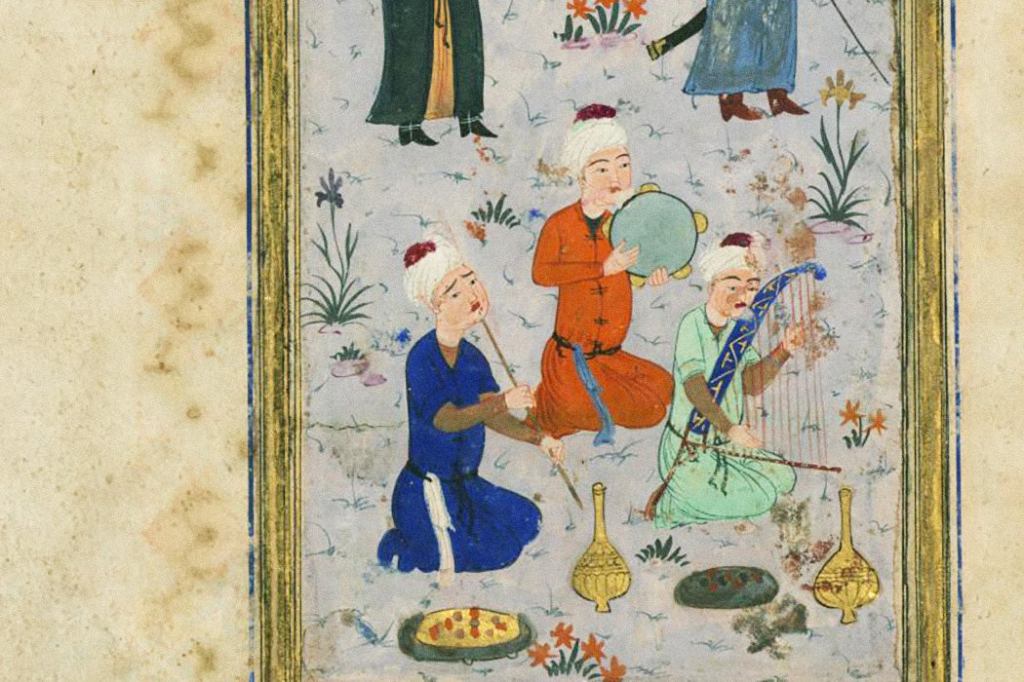
The other day, my fourteen-year-old nephew helped me sort my books. He lifted “Son of Sin“, blinked at the cover, and asked whether it was about homosexuality. I replied, “Yes, the author is queer, and so am I.” He registered that with the rapid attention of his generation, then asked, “Really?” I said, “Yes, particularly with gender.” I began to tell him about mukhannath (effeminate men), their role as musicians and queerness in Islamic histories. He quipped, “Oh. So a performative male.”
That quip lodged in me. It was quick, witty, precisely Gen-Alpha: the compression of a thousand cultural movements into two words. It was also quite elucidating. My nephew’s use of performative male captured an entire contemporary linguistic ecology: the way the term performative has drifted from its philosophic and queer-theoretical pedigrees into the sketchbook of meme culture, into a shorthand that signals “posturing” or “inauthenticity.” But his gibe also made me ask a deeper question: what does it mean to embody effeminacy or queerness? And what is lost — politically, ethically, epistemically — when shorthand dismissals collapse those embodied practices into caricature?
I want to trace that argument slowly and generously: first, by locating the word’s intellectual lineage; second, by showing how and why that lineage has been transformed by social and technological forces; third, by dwelling on embodiment: what it means to live an effeminate or queer body as a practice rather than a posture; fourth, by asking what it means to be a genuine ally rather than a “performative” one; and finally, by examining the epistemic violences unleashed when language is used to silence or discredit embodied knowledges.
From Austin to Butler to the Feed
The term performative begins in a tightly technical register. J. L. Austin’s speech-act theory described certain utterances as performative: they do things. Saying “I apologize” or “I promise” is not merely describing an act; the utterance enacts the relational shift. This insight places language inside causality: words do not just map the world, they help make it.
Judith Butler then reworked this move: gender is not a pre-existing property that one merely expresses or discovers, Butler argued; it is constituted through reiterated acts — speech, gesture, posture, habit — that produce and sustain the appearance of a stable gendered subject. Performativity, in Butler’s hands, names a mechanism of social production: repetition makes reality legible and durable. Performativity here is world-making, not fakery; it is the machinery by which bodies come to count.
But as scholars and critics have observed, performative in public discourse has inverted: it commonly now means “done for show,” “insincere,” “virtue-signalling.” David McClay’s Hedgehog Review essay gives a lucid diagnosis of this inversion: a term whose paradigmatic example was the wedding vow (“I do”) — language that makes — has been flattened into a pejorative tag for hollow gestures. This inversion is visible and consequential: it retools our cultural grammar for evaluating speech, action, and moral credibility.
All of this sets the scene. But the bigger story is not only about lexicon; it is about how the technologies through which we speak (platforms, feeds, virality) are now also engines of semantic mutation. Algorithms privilege repetition and emotional legibility, which accelerates kinds of semantic bleaching and pejoration that used to take decades. The result is a public vocabulary that is often affectively exact and conceptually sloppy.
The Linguistic Mechanics of Drift
Linguists name this family of transformations semantic change (also called semantic shift or semantic drift). The specific moves we see with performative include:
Semantic bleaching or desemanticization is the weakening of a word’s specific force through overuse or diffusion into broader contexts.
Pejoration is the evaluative downgrading of a term (a neutral descriptor acquires negative valence). Performative has slid toward pejoration: it’s more likely to be used as an accusation than an analytic tool.
Subjectification is the reorientation of meaning from a world-describing function to a speaker-stance function: the word comes to encode the speaker’s attitude (“I see your act as fake”). This is linguistically traceable and socially intelligible.
Sociocultural catalysis is when social practices (memes, influencer aesthetics, political spectacle) and platform dynamics accelerate and shape semantic trajectories. Frequency, salience, and affective payoff make certain new meanings stick.
These are not metaphors but processes whose patterns are visible in corpora and in the social life of words. The drift of performative illustrates how theoretical vocabulary can become both more democratised and more brittle when it leaves specialist contexts.
The Body as World-Making
If Butler tells us gender is constituted in repeated acts, we need to ask: what is the phenomenology of those acts? What does it mean, practically and somatically, to embody effeminacy or queerness? Here the analytic lineage moves from speech acts to lived bodies.
Maurice Merleau-Ponty gave us the starting point for thinking about the body not as an object that has experiences, but as the subject through which experience happens. “The body is our general medium for having a world,” he wrote: perception, movement, and habit are the means by which we inhabit and craft our lifeworld; embodiment is not secondary to thought, it is the condition of meaning.
Feminist theorists such as Elizabeth Grosz extend and que(e)rify Merleau-Ponty by insisting that bodies are also historically and sexually specific: bodies bear material histories of power, injury, pleasure, discipline, and creative invention. Grosz’s Volatile Bodies insists that bodily difference is not simply given; it is shaped by ecological, political, and cultural forces: and it is through the body that norms are both enforced and broken. This matters for effeminacy: the gestures, timbres, and postures that mark “softness” or “femaleness” are not mere styles one adopts; they are embodied practices formed over time by social habit, training, constraint, and invention.
To embody effeminacy is to cultivate a set of corporeal skills, habits, and sensory orientations that orient the world differently. A manner of walking, the modulation of the voice, a taste for ornament, the inclination toward certain spaces: these are virtuoso acts, habitually performed, learned within psychical and social economies. They are not merely performed as in theatre; they are practiced in the world so that the body itself becomes an index of orientation and relational belonging.
José Esteban Muñoz’s queer futurity literature invites us to read such acts as not only present but forward-turning: queerness is often an orientation toward possible futures, enacted now in embodied ways that refuse normative timelines and rhythms. The body thus becomes a site of temporal and ethical futurity: an archive of small gestures that gesture otherwise.
What It Means to Embody Queerness or Effeminacy
Let’s make this less abstract.
Let’s consider small, everyday facts of embodied life that scholarship has documented across cultures:
In some Islamic histories, mukhannathun functioned as musicians and mediated sonic forms of desire and mourning; their vocal qualities — ornamentation, timbre, melodic role — were part of how gendered affect was transmitted. These were not simply decorative roles; they were relational and sometimes socially protected or precarious positions that allowed particular affects to circulate. Scholars note that hadith literature’s references to mukhannathun are complex and historically debated about sexuality and social function — the archive resists a single reading.
Dance, hand movements, posture; the way a body carries its shoulders or modulates a laugh encodes habit and history. These gestures are learned, often from other bodies, and bear the imprint of social sanctions and permissions. To be effeminate in some contexts is to have cultivated gestures that index belonging to particular communities of practice; these gestures often function as knowledge about social relations, desire, and safety.
Sara Ahmed’s queer phenomenology asks us to notice orientation: how bodies point toward objects, places, and others. Queer orientation involves inhabiting spaces differently (desire lines, as Ahmed calls them): the embodied queerness that draws a person to certain clubs, corners, or language registers is not superficial; it is an orientation produced by habit and affective attachment.
For many queer and gender-variant bodies, embodiment includes embodied risk assessment: knowing how to pass, when to avoid eye contact, when to assert, the rhythms of leaving a party early. These are forms of practical knowledge that gestures and memes cannot capture. Such embodied practices are often the product of survival and community wisdom.
Each of these registers — musical/vocal, gestural, attentional, survivalist — constitute the anatomy of embodied queerness or effeminacy. To reduce those practices to “a pose” or “a posture” is to ignore the labour, history, and stakes that make those acts intelligible and consequential.
When Language Dismisses Lived Knowing
Here we must attend to the cost: calling someone “performative” as shorthand for “fake” is not merely a linguistic move; it is often an epistemic one. Gayatri Spivak’s diagnosis of epistemic violence and Miranda Fricker’s work on epistemic injustice are useful lenses: systems and individuals can wrong someone in their capacity as knower, by denying credibility (testimonial injustice) or by withholding the collective interpretive resources a group needs to articulate its experience (hermeneutical injustice).
When someone says “performative male” and thereby refuses to engage the embodied testimony of a gender-variant person, they may be committing testimonial injustice: their prejudice (that the body is a pose) reduces the speaker’s credibility. When a community lacks the language to understand a form of effeminacy, and the dominant public vocabulary replaces that lack with a dismissive label, that is hermeneutical injustice: the group’s experiences are rendered unintelligible in public knowledge systems. Both harms are epistemic and moral.
Moreover, epistemic violence works structurally in colonial and racialised registers: the languages of European epistemology have historically named and categorized non-European forms of gender and sexual difference in ways that extract, pathologize, or erase. Calling a complex local practice “performative” in a context where the term already carries ideological weight can reproduce colonial flattenings: as Spivak warns, the epistemic apparatus of empire rearranges who can speak and who is believed.
To see the epistemic stakes concretely: imagine a Muslim man who sings with ornamentation and uses what outsiders call “feminine” timbres in devotional gatherings. A dismissive onlooker’s “he’s just performative” can be a silencing move: it ignores the singer’s knowledge about community, lineage, and ritual; it discredits embodied testimony; it forecloses conversations that might reveal that the practice is, in fact, a sophisticated mediation of affect and devotion. The verdict of “performative” thus functions as a quick epistemic triage, and, often, it chooses the easiest and most comfortable reading for the dominant ears.
Allyship Beyond the Gestural
If language can inflict epistemic harms, then being an ally means more than saying the “right things” or posting the right slides. It demands sustained, embodied labour.
bell hooks and many feminist interlocutors insist that allyship is work: it involves studying, refusing privilege, being present to redistribute power, and taking risks in solidarity. It cannot be a merely visible performance that accrues praise without cost.
Contemporary scholarship on performative allyship makes this explicit: performative allyship refers to low-cost claims of solidarity — hashtags, temporary profile frames, virtue-signalling — that don’t challenge structures or redistribute resources. Empirical studies and reviews show that performative allyship can even be harmful, because it creates illusions of change while foreclosing real work. Real allyship, by contrast, is costly: it requires listening when it’s inconvenient, acting when it’s unrewarding, and accepting critique without defensiveness.
What does embodied allyship look like, then?
Learn the conceptual history of terms you deploy; read beyond headlines and slides.
Use your social capital to amplify voices in ways that do not extract or tokenize. Put power, not just words, where your mouth is.
When called out, accept the epistemic weight of the critique and change practices rather than perform penitence for attention.
Support institutions, mutual aid, archives, and spaces where embodied knowledges are preserved and shared: not just the moments when they are photogenic.
Remember that listening is not passive: it involves shaping time, attention, and physical presence.
These are not theatrical acts. They are slow, often invisible, and costly: precisely the features that make platforms devalue them. To be a good ally means to resist the economy of visibility and to practice accountability in ways that rework relations of credibility and power.
When the Label “Performative” Silences
Let’s return to the immediate stakes.
Calling someone “performative” can do several harms:
It obscures the historical continuities and community practices (like ritual singing, dress codes, roles like mukhannathun) that make certain embodiments meaningful. The label substitutes a quick moral aesthetic for historical listening.
It can delegitimate first-person testimony by marking the speaker as inauthentic. Fricker’s testimonial injustice shows how prejudice can lower credibility and block knowledge circulation.
It turns attention to embarrassing optics rather than structural critique: e.g., shaming a man for posting an emotional video instead of demanding institutional changes in care, safety, or policy that produce heartache in the first place.
By policing presentation, the label polices the boundaries of legitimate gender expression, consolidating a narrow norm that excludes embodied deviations.
These are not abstract claims. They are a gathering of small harms that aggregate into epistemic and material exclusion.
Queer Use, Queer Reuse
If drift is inevitable, what is our ethical response?
Sara Ahmed gives us one model: queer use. Instead of trying to police a word’s usage or to reclaim it in a stiff archival sense, queer use asks us to attend to how words are used and to purpose them otherwise: to make use audible, to notice the slippages, and to bend language toward different ends.
This is not a call for linguistic purism or sentimental rescue. It is a methodological and ethical practice: watch how words are taken up, note the harm or possibility that accrues, and choose to re-perform them in ways that restore lineage, credit, and interpretive density. That means teaching, not shaming, and building interpretive infrastructures (archives, glossaries, community histories) that allow embodied practices to be heard on their own terms.
We can make performative useful again. Not by snapping it back into academic purity, but by using it with attentiveness: reserving it for claims about how acts constitute social forms, and refusing its lazy inversion as a dismissal.
Generational Drift and Generous Pedagogy
My nephew’s joke will continue to be generative for me. It condensed how language migrates: from Austin to Butler to memes, from courtrooms and lectures to sneakered teenagers scrolling the feed. But the joke is also a lesson: younger generations remix theory and archive into new vocabularies precisely because the older custodians often kept theory inaccessible. We should be less horrified by drift and more committed to pedagogies that are both generous and exacting: teach the history, but also teach how to listen.
This is the decolonial imperative: not to guard words jealously as museum pieces, but to make them legible in multiple languages, contexts, and bodies while remaining vigilant about the epistemic harms that careless shortcuts produce. Reclaiming performative is not an act of linguistic nostalgia. It is a political practice: re-attaching the word to the work it once did, to show how acts constitute worlds, and refusing the easy dismissal that erases bodies and histories.
Yet, What Do The Hadith Say?
Islamic textual traditions record the category of mukhannath but with far more nuance than modern stereotypes suggest. A key hadith graded Sahih (authentic) in Sahih Muslim 2180 recounts the presence of effeminate men in the Prophet’s household and their interactions with women.
Al-Nawawī comments on these traditions, explaining that scholars have historically distinguished two types of mukhannathun:
“First, one who was created that way and he is not responsible for his behavior resembling women — their appearance, their speech, and their movements. Allah created him upon his disposition, so this is not blameworthy for him, nor a fault, nor a sin, nor is he punished. He has the excuse of not being able to control that. For this reason, the Prophet (ṣ) did not condemn him at first when he entered the homes of women, nor his behavior as it was originally his disposition. Indeed, he condemned his behavior after his deliberate imitation of women was made known to him, and he did not condemn his description as an effeminate man in itself… Second, an effeminate man whose disposition is not like that. Rather, he is responsible for his behavior resembling women, their movements, their appearance, their speech, and mimicking their presentation. This is blameworthy as has come in the authentic traditions cursing him… As for the first type, he is not cursed.”
— Sharḥ al‑Nawawī ‘alā Ṣaḥīḥ Muslim 2180
This distinction is critical: the first type shows that effeminacy, as a natural disposition, was recognized as morally neutral: a lived embodiment of gender difference, not a performance of sin. The second type refers to deliberate imitation for social gain or deception, which the tradition treats as ethically accountable.
In contemporary terms, this means that when shorthand labels like “performative male” are applied broadly, they often erase the first type entirely. What might be a natural, embodied effeminacy — a way of inhabiting the world, expressing affect, or aligning with musical, ritual, or social practices — is collapsed into moral judgment. This is precisely the kind of epistemic violence discussed by Spivak and Fricker: lived knowledge, embodied history, and the subtleties of gendered disposition are overwritten by a single, dismissive term.
In the future of my dua:
language may loosen without losing its lineage
younger generations find theory not as jargon but as shelter
we resist the pleasures of the quick verdict
allyship becomes practice, not performance
archives and oral histories are resourced
epistemic harms are acknowledged, named, and tended to
embodiment is honoured as knowledge
decolonial feminist practices multiply
words may drift and still be used well
we practise queer use to make different forms of life possible.
 IMAAD MAJEED
Leave a comment